
December has a way of arriving faster than most business owners expect.
One minute, you’re working through summer schedules, vacations, customer needs, and everything else that keeps the day moving. Then suddenly, you’re looking at the final quarter of the year and wondering where the time went.
That’s usually when questions start coming up.
- Are the books current?
- Are estimated taxes on track?
- Who still owes us money?
- Do we need to buy equipment before year-end?
- Are payroll and contractor records ready for January?
At A Mazzo Accounting, we’d rather help business owners ask those questions before December.
Starting your year-end review in September or early fall gives you something December can’t always give you: time.
Time to clean up your records. Time to review your numbers. Time to make thoughtful decisions. And time to talk with your accountant before the calendar closes the door on certain options.
Quick Answer: What Should a Small Business Review Before Year-End?
Before year-end, a business should review its cash flow, unpaid customer invoices, bills and debt, estimated taxes, planned purchases, payroll and contractor records, and goals for the coming year.
Starting that review before December gives you more time to correct problems, ask questions, and make decisions based on what your business actually needs.
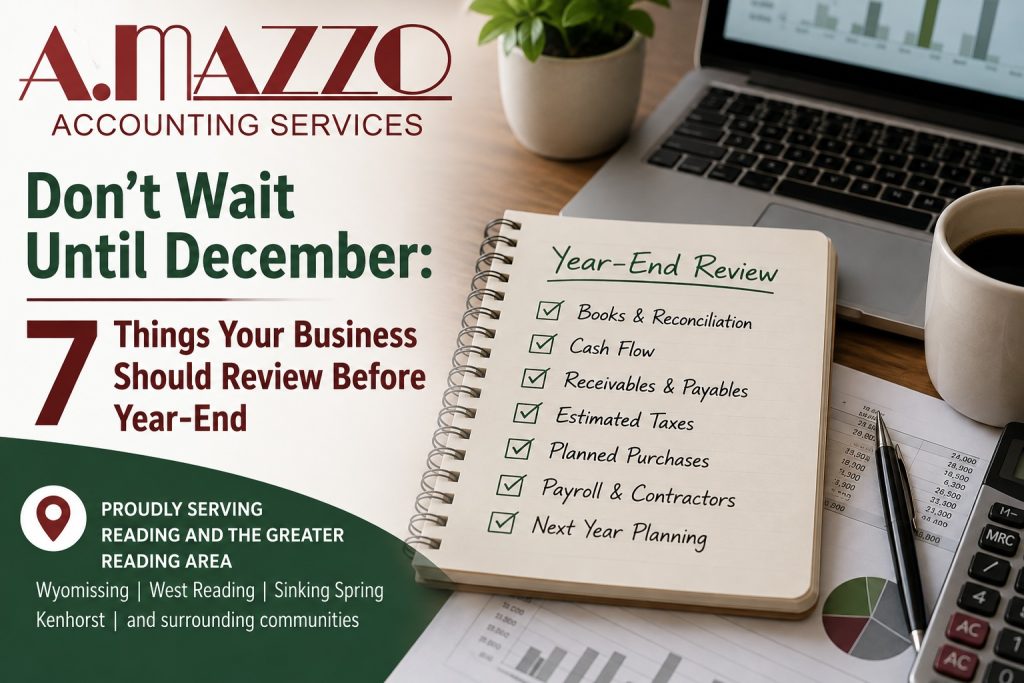
Here are seven areas we recommend looking at now.
1. Are Your Books Really Up to Date?
This is the first place we’d start.
Your accounting records should tell you what’s happening in your business now, not what happened three or four months ago.
Take a look at your accounts and ask:
- Are your bank accounts reconciled?
- Are your credit card accounts reconciled?
- Have income and expenses been entered correctly?
- Are business and personal purchases separated?
- Are there transactions sitting in an uncategorized account?
- Are loan balances recorded properly?
- Have major equipment or asset purchases been entered correctly?
The numbers can look complete and still have problems hiding underneath.
Maybe a Reading-area contractor purchased equipment that was recorded as an everyday expense.
Or maybe a professional office in Wyomissing has customer deposits sitting in the wrong income category.
Maybe a business owner has been using one credit card for both business and personal purchases with every intention of sorting it out later.
Later becomes much more challenging in January.
The sooner those items are reviewed, the easier it is to correct them and get a clearer picture of how the year is really going.
2. What Is Your Cash Flow Telling You?
Profit and cash in the bank aren’t the same thing.
That surprises a lot of business owners.
A business can show a profit on paper and still feel short on cash. It can also have a healthy bank balance today while payroll, taxes, loan payments, vendor bills, and other obligations are waiting around the corner.
That’s why cash flow deserves its own review.
Ask yourself:
- How much cash is coming into the business each month?
- What are your largest regular expenses?
- Are your costs higher than they were earlier in the year?
- Do you have enough set aside for upcoming tax and payroll obligations?
- Are credit card or loan balances increasing?
- Are there seasonal changes coming?
- Did the business perform the way you expected it to?
This can be especially important for businesses throughout Greater Reading.
A retailer or restaurant in West Reading may be preparing for a busy holiday season.
Or contractors in Sinking Spring may be thinking about slower winter months.
A professional office in Kenhorst may have fairly steady revenue but several annual expenses coming due before January.
Looking ahead gives you the chance to plan instead of simply reacting when the bills arrive.
3. Who Still Owes You Money — and What Do You Still Owe?
Year-end planning isn’t only about taxes. It’s also a good time to clean up accounts receivable and accounts payable.
Start with the money customers owe your business. Pull an aging report and take a look.
- Which invoices are current?
- Which are 30, 60, or even 90 days past due?
- Are there invoices that were paid but never marked correctly?
- Are there customer balances that need a follow-up before the holidays?
- Then look at the other side.
- What does your business owe?
Review vendor bills, credit cards, loans, recurring subscriptions, and upcoming obligations.
Make sure what your accounting system shows matches what is actually due.
An old invoice that probably won’t be collected can make the business look stronger than it really is.
A vendor bill that never made it into the books can make expenses look lower than they really are.
Neither one helps you make good decisions.
Cleaning up both sides gives you a better picture before the final quarter moves too far along.
4. Are Your Estimated Taxes and Tax Planning on Track?
This is one area where waiting until December can really limit your choices.
Tax preparation looks backward.
Tax planning looks forward.
By September or early fall, you usually have enough of the year behind you to begin estimating where income may land and whether anything needs attention before December 31.
Some questions worth reviewing include:
- How does year-to-date income compare with last year?
- Have estimated tax payments been made as planned?
- Has the business grown significantly?
- Was this year slower than expected?
- Are there large gains, losses, or unusual transactions?
- Has owner compensation changed?
- Has payroll changed?
- Are there major expenses still expected before year-end?
A strong year is good news, but it may also mean a different tax picture than you expected back in January.
A slower year can create a different set of planning questions.
The important part is knowing where you stand while there is still time to talk through the options.
5. Are You Planning a Large Purchase Before Year-End?
We hear this question every year:
“Should I buy something before December 31 so I can deduct it?”
Our first question is usually different:
Do you actually need it?
A tax deduction can reduce taxable income, but spending money you don’t need to spend simply to create a deduction usually isn’t a good business decision.
Business needs should come first.
Before purchasing a vehicle, computer system, machinery, office furniture, or other major equipment, think through a few questions:
- Does the business need this now?
- Is the cash available?
- Will financing create a cash-flow issue next year?
- When will the equipment actually be placed in service?
- How will the purchase be recorded?
- What tax treatment may apply?
A contractor in Sinking Spring may truly need a new piece of equipment before winter.
A business in Wyomissing may have aging computers that are slowing down the team every day.
Those are business reasons.
Then your accountant can help you look at the accounting and tax side of the decision.
That’s a much better order.
6. Are Your Payroll and Contractor Records Ready for January?
January paperwork is easier when you don’t wait until January to start preparing for it.
Now is a good time to review employee and contractor information.
For employees, check names, addresses, Social Security information, and payroll records.
For independent contractors, make sure you have current W-9 forms and accurate payment records.
You don’t want to be tracking down missing information when W-2s and 1099s are already due.
There are also reporting rules that can change from year to year, which is another reason this area deserves attention before year-end.
At A Mazzo Accounting, we help businesses with payroll services, year-end forms, and federal, state, and local payroll reporting.
Clean records now make January much easier.
7. What Do You Want Your Business to Look Like Next Year?
This may be our favorite year-end question because it moves beyond paperwork.
Your accounting records shouldn’t exist only to prepare a tax return.
They should help you run the business.
Take a look at the numbers and ask:
- Which services or products were most profitable?
- Where did expenses increase?
- Did payroll grow at the same pace as revenue?
- Are you carrying more debt than you expected?
- Did you meet your revenue goals?
- Where did cash feel tight?
- What worked especially well?
- What do you want to change next year?
Maybe you want to hire someone, or buy equipment, or decide prices need to change.
Maybe one part of the business is growing while another is taking up a lot of time without producing enough return.
Or maybe the business had a very good year and you want to understand how to build on it.
The numbers can help with those decisions.
But only when they’re current and you actually take the time to look at them.
A Simple Year-End Business Checklist
You don’t need to tackle everything at once.
Start here:
- Reconcile bank accounts
- Reconcile credit cards
- Review income and expense categories
- Look at your year-to-date profit and loss
- Review your balance sheet
- Look at cash flow
- Follow up on unpaid customer invoices
- Review outstanding vendor bills
- Check estimated tax payments
- Review projected year-end income
- Look at planned equipment or vehicle purchases
- Confirm employee payroll information
- Collect missing contractor W-9 forms
- Review contractor payments
- Compare this year’s results with your goals
- Start outlining next year’s budget and priorities
- Schedule a year-end conversation with your accountant
You don’t have to finish the whole list in one afternoon.
Pick one area.
Get that in order.
Then move to the next.
Small steps now can prevent a much bigger scramble in December.
Why Starting Early Makes a Difference
We work with small and mid-size businesses throughout Reading, Wyomissing, West Reading, Sinking Spring, Kenhorst, and communities around the Greater Reading area.
And one thing we see again and again is this:
Business owners don’t usually need more reports.
They need someone to help them understand what the reports are telling them.
Accounting should help you see what is working, what needs attention, and what questions you should be asking next.
That’s why year-end planning shouldn’t begin when the year is practically over.
Starting early gives you more time to understand where the business stands and make decisions with a little more breathing room.
Ready to Take a Look at Where Your Business Stands?
Should you want help reviewing your business before year-end, we’re here to help.
A Mazzo Accounting provides business accounting, payroll, tax preparation and planning, and business consulting for businesses throughout Reading and the Greater Reading area.
Give us a call at 610-775-9216 or reach out to schedule a conversation.
The goal isn’t to make year-end more complicated.
It’s to make it clearer.
Frequently Asked Questions
When should a small business start year-end planning?
September or early fall is a good time to begin. By then, you usually have enough year-to-date information to review cash flow, taxes, payroll, and business performance while there is still time to make changes before December 31.
What accounting reports should I review before year-end?
Start with your profit and loss statement, balance sheet, accounts receivable, accounts payable, bank reconciliations, credit card reconciliations, and cash‑flow information. Together, these reports give you a more complete picture of the business.
Should I buy equipment before December 31 for a tax deduction?
Not automatically. A purchase should make sense for the business first. Before making a major purchase, talk with your accountant about timing, cash flow, how the asset will be recorded, and the potential tax treatment.
What contractor information should I collect before year-end?
Make sure you have completed W-9 forms and accurate payment totals for independent contractors. Reporting requirements can vary based on the type of payment and current tax rules, so it’s a good idea to review contractor records before January.
Why should I meet with my accountant before tax season?
A year-end conversation gives you time to review current numbers, estimated taxes, purchases, payroll, cash flow, and business plans before the year closes. Once the year is over, some planning choices may no longer be available.
Does A Mazzo Accounting work with businesses outside Reading?
Yes. A Mazzo Accounting serves businesses throughout Reading, Wyomissing, West Reading, Sinking Spring, Kenhorst, and towns and villages throughout the Greater Reading area.