
Quick Answer
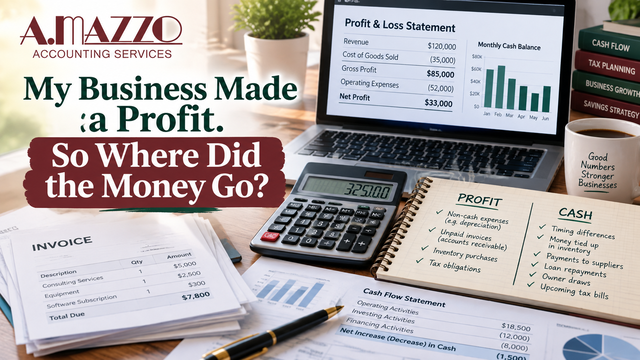
A business can show a profit on paper and still feel short on cash. That happens because profit and cash flow are not the same thing. Money may be tied up in unpaid invoices, equipment purchases, loan payments, payroll, taxes, inventory, or other expenses that do not always show up the way a business owner expects.
That is one of the most frustrating questions a business owner can ask.
“We made money this year, so why does the bank account not feel like it?”
You look at the profit and loss statement. It shows a profit.
Then you look at the checking account. That tells a very different story.
At A. Mazzo Accounting, we help business owners understand what the numbers are actually saying so they can make better decisions instead of guessing.
What Is the Difference Between Profit and Cash Flow?
Profit is what remains after business income and expenses are calculated for a specific period.
Cash flow tracks the actual money moving in and out of the business. Those numbers can be very different.
For example, you may record a sale this month, but the customer may not pay the invoice for another 30, 60, or even 90 days.
The sale can contribute to your profit. But the cash is not in your bank account yet.
That difference matters.
Are Unpaid Invoices Tying Up Your Money?
Accounts receivable can have a big effect on cash flow.
A business may be busy, sales may look strong, and profits may appear healthy, but unpaid invoices mean the cash is still sitting with the customer.
Take a look at how much money customers currently owe you.
Then ask:
How old are those invoices?
Are customers consistently paying late?
Are certain accounts becoming a pattern?
Sometimes improving the way invoices are sent and followed up on can make a noticeable difference.
Did You Spend Money on Equipment or Other Big Purchases?
Large purchases can also make cash disappear faster than expected.
Maybe you bought equipment, a vehicle, computers, furniture, or another asset for the business.
The cash may leave your bank account immediately, but the accounting treatment of that purchase may be spread over time.
That is one reason the profit shown on your reports may not match what happened in your checking account.
What About Loan Payments?
Loan payments can be confusing too.
Part of the payment may be interest, which is generally treated as an expense.
Another part reduces the amount you owe on the loan.
That principal payment still uses cash, but it does not always affect profit in the same way a normal operating expense does.
So the business may be profitable while a significant amount of cash is going toward debt repayment.
Are Payroll and Taxes Taking More Than You Expected?
Payroll can be one of the largest regular cash demands in a business.
Then there are payroll taxes, estimated tax payments, sales taxes, insurance, retirement contributions, and other obligations.
These payments may happen at different times throughout the month or quarter.
That timing matters.
A profitable business can still feel squeezed when several major payments come due close together.
Are You Looking at the Right Reports?
Your profit and loss statement is important.
But it is not the only report worth reviewing.
A business owner should also understand the balance sheet, accounts receivable, accounts payable, bank balances, debt, and cash flow.
You do not need to become an accountant.
But you should be able to answer a few basic questions:
- Who owes us money?
- What do we owe?
- What major payments are coming up?
- How much cash do we actually have available?
- Is the business generating enough cash to support its day-to-day needs?
What Should You Do When the Numbers Do Not Make Sense?
Start by asking questions.
Do not assume that a profitable business automatically has strong cash flow, and do not assume a tight bank balance means the business is failing.
Sometimes the issue is timing, slow-paying customers, or even debt.
Sometimes expenses have quietly increased.
And sometimes the business simply needs a clearer plan for how money moves through it.
At A. Mazzo Accounting, we help business owners look beyond one number and understand the full picture.
Should your business be showing a profit but the cash still seems to disappear, it may be time to take a closer look at where the money is actually going.